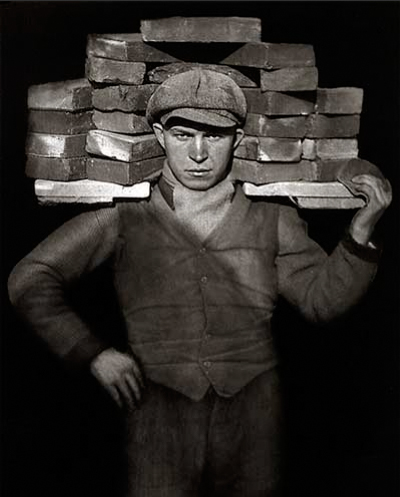
The work of August Sander could not go without mentioning in this project seeing as he dedicated his career and efforts documenting German citizens in the early twentieth century. Photographing an array of people from various social backgrounds from peasants to farmers, skilled craftsmen to intellectual physicians and professionals. Fundamentally Sander's intention was to produce a visual record for every type of person in Germany to make a permanent recollection of that time. Consequently his work could possibly be thought of as a pictorial census. Within each one of his portraits the subjects are predominately dressed in their occupational attire, confidently posed within their surroundings with the tools their trade in their grasp. They confront viewer with a rather clinical expression but their body language conveys a deep sense of pride in what they do and how their position contributes to the community.
 Looking at Sanders work, one can easily spot the pastry cook from the farmer. Attributes and uniform aside, there's a constant stereotypical aspect to his portraits regarding the physical frames of the subjects and how that responds to general perception of each occupation. The pastry chef conforms to the traditional image to someone who works with food i.e being round and big bellied. The bricklayer has a much more toned and broad structure which supports the tough physical demands that comes with his job and then there's the farmer, lean and agile from the organic lifestyle he leads, with a weather beaten complexion. Its interesting to observe these perfect representations as they stood then compared to the modern working world, where these types stereotypes have all but disappeared. I think that is why there's a great appreciation for Sanders portraits as they are classic raw images frozen in time that not only demonstrate the individuals but also the society, both of which inevitably change and alter in reality.
Lothar Wolleh

 Within the frame its clear to see how at ease the artist is, surrounded by their creations. As a final polish, Wolleh incorporates the artist unique behavior to characterize their individual portraits. This is accomplished by constructing quirky compositions. Take the portrait of Renee Magritte for example, standing in front of one of his own paintings, "The Invisible Man", not only does it embrace the surrealist's renowned trademark, one could also argue that it portrays an essence of Magritte himself. Notice that his suit identically mirrors the one in the painting indicating that maybe Magritte uses himself as inspiration to be in some way or another always be present in his paintings. If that is the case, his presence couldn't be more defined in this circumstance, he's standing in front of the painting almost as if he's just crept out of it. Its also intriguing for the viewer to observe a professional in a different way from how they might of ever imagined to. This is where I feel an aspect realism is brought to life in these portraits.
  The artists you see before you are instantly recognisable. They are considered celebrities in the art world and consequently we have a fascination with celebrities and always wanted to discover what they get up in their private lives. In a similar context, same could be said about these portraits. For the first time the viewer is actually concentrating on the artist themselves rather their paintings. I'm referring to the portrait of Man Ray in his study as I feel this sums up my point more coherently. He is memorable and inspirational figure to many, I myself have been deeply inspired by this man's great accomplishments and yet to see him casually sitting in an ordinary looking study in such a relaxed manner kind of contradicts what you would expect or preconceive. In any other words it makes him more or less look like just an ordinary person and after all that's what every celebrity is. So when you see an image like this it puts forward the idea that a person behavior alters in various environments. This has some relevancy to my work as I'm documenting my subjects in their private living space which again is something I've never been exposed too and will in no doubt contradict my preconceived thoughts about them.
 Lewis Hine
"There is work that profits children and there is work that brings profit only to employers. The object of employing children is not to train them, but to get high profits from their work".
 In 1908 Lewis Hine was assigned by the National Child Labour Committee to record the mass exploitation of young children in busy manufacturing industries. The purpose for this assignment was to exposed the harsh reality of child labour in hope that it would change public opinion and encourage authorities to in some ways reduce and eventually ambolish the scheme indefienently. Hine dedicated his time to shoot in various locations such as, cotton mills, factories, even mines and typically anywhere else where exploitation blossomed. His photographs speak for themselves and have a lasting affect on whoever views them. Philsopher Adam Smith proposed that we as humans have an ethical sense organ that inconsciously shapes our judgements. I feel this to be somewhat true as generally we all feel an natural attraction to things like genorosity, kindness and love and similarly we generally feel a natural revulsion towards things like selfishness, cruelty and hate. I feel that this moral nature seems to play a dominant role in this type of photography.
Take for instance Hine's portrait of a young girl who works as a cotton spinner, there is an essence of charming and disarming little girl like qualities to her. She's wearing a frilly dress and her hair is braided with a bow to hold it in place. She could easily be mistaken for a toy doll. However her surroundings contradict this idea. Instead she is placed in an industrial prison, heavy machinery to her right and a thick grimy windowed wall to her left, there is no way for her to escape the situation. By setting this doll-like figure in this awful environment, Hine is telling us that she just doesn't belong where she is,there is literally something wrong with this picture and we viewers can instantly sense this. It makes us sorry for her and angry at the people who placed her there. Her intensive gaze completes the scene, her expression not sad but rather accusative as if to say "why aren't you doing anything to get me out of here".
 Baudouin - The Stuff of Character
 I've taken a deep interest in French photographer Baudouin's work. A commercial/editorial artist by practice he has shot for well known advertising companies and fashion magazines, Elle, Le Monde, Ikea and L'Oreal to add credentials to his name. Mostly all of his photo shoots consist of interior shots in various household rooms where one or two models are placed within the scene. However Baudouin goes against the grain with portraiture and this is why I envy him. Unlike many photographers who present subject as the dominant point of focus with background elements adding small fractions of interest, Baudouin on the other hand introduces the idea that the environment and our possessions are a part of us. He believes that we are not defined by what we look like and that our personalities and true characteristics are only clearly seen when we are surrounded by our stuff. I've also noticed that when I look at environmental portraits my eyes always lead me to look straight at the subject before acknowledging the other aspects within the frame.
  With Baudouin's work this isn't so, I see the whole image for what it is and all of the details in one glance. Even the subject are sometimes hard to find,camouflaged amongst the hoard of collected items and furniture they complete the scene and become part of the environment, as if they just are another prop in room. I imagine I will get similar results with my idea. I plan to briefly interview each one of my subjects before taking their portrait. I feel by gathering a bit of background information on them will give me more ground to work with in terms of how their apartment might portray an essence of them and how I can best represent their individual characters.
 James Mollison - Where Children go to sleep

 This book well and truly fascinates me. It reveals stories of children from all around the world, from all different cultural backgrounds. The idea is relatively simple, the child's portrait is paired with a separte photograph of their bedroom, but what makes it stronger is the power that each portriat conveys and the diversity of atmospheres captured in each room. Some might question as to why Mollison just didn't photograph the children in their bedroom there and then producing one final image. However I think this approach of having two separate images is more effective because visually we can see the distinct relationship between the child and their bedroom.
  I find this piece of work very endearing, but there is something that bothers me. I guess Mollison's intention was to show the children as individuals, as equals, just as children; however they also look like freakish stereotypes attempting to represent a catergory, a race or a country. I also sense something odd, maybe too staged about some of these children and they way they are posed, there's something rather adult about their facial expressions and the absence of mischievous smiles that prevents me from connecting emotionally to them. You feel like an outsider, intruding into their homes but I can't help but wondered whether some these of these kids are real, or whether they are improvised characters paired with set up scenarios.
Tina Barney

 I find the work of Tina Barney heavily inspiring. As always i'm a lover for images that challenge traditional patterns and introduce new methods of documenting, so naturally I became instantly compelled to these unconventional family portraits. Barney has always had a particular interest in photographing wealthy families within their rich dwellings. Its clear to see that she is driven by innovative and elaborately designed interiors and has stated that she cannot produce an interesting image without shooting in an interesting interior. Shes also fascinated in how the way people dress tends to match the way they decorate their houses. The entire decor of the room from the art on the walls to the furniture and objects scattered around tells us a lot about the people she is photographing. These images also differ from the usual candid family group shot, there appears to be more of a hidden depth to them. You can sense a disconnection between certain members within each family unit.
  In the image entitled "Daughters" we see a man and woman who you assume are husband and wife and three young girls who are obviously the couple's daughters. They are standing in what appears to be a luxurious living room, but I find it rather unusual in the way the family have positioned themselves. Specifically in the way the woman is standing in the foreground with her back turned away from her husband who is standing meters behind. The three daughters have evenly arranged themselves out as a way of filling up the empty space, two are standing alongside each of their parents with the other occupying the area that separates the two adults. Its as if Barney as pressed the shutter moments after a marital argument occurred. The girls also look disorientated and confused, not sure how to react to the situation. The loving affection that once existed between the couple has now gone and the only connection they share with each other is via their children. This why I think Barney is credited more as a photographer because a number narratives and silent commentaries run alongside her images revealing things that we are not meant to see. We are observing the wealthy caught up in scenarios that fundamentally occur in every family home and this humanizes them because these situations can be replicated in other families from different class backgrounds.
 Madga Segal - Exploring 20th Century London

 The neighborhoods she targeted significantly varied in reputation and this is clearly demonstrated in her images. By portraying the subjects as stereotypical characters occupying certain places also makes this project a true representation of surburban London. I find it quite ironic that even though Segal has entitled each of her portraits with the subjects job title and location of where they live, the viewer could still identify this because inadvertently we make associations of an area and the people who live there. So in this case, the single mother in Camberwell is most likely living on urban estate with her two young children. The content of the room is cluttered with toys and cheap furniture and the way she is casually stood in between her two children smoking and inappropriately dressed in a skimpy outfit just sums up her whole persona.
In stark contrast to the business woman in Chelsea, posed in a swish townhouse living room. Dressed smartly in a suit and not a hair out of place she stands with pride and dignity amongst quality antique furnishings. I find this an effective case study, but what might be more interesting is if Segal was to revisit these neighborhoods almost two decades later to see how much things have changed over time and whether the different communities have altered or expanded in way.

No comments:
Post a Comment